A buyer touring downtown San Diego this summer can walk three units in one afternoon and come away thinking they found three versions of the same option. Same price band, same square footage, same skyline view from the fourteenth floor. The listing photos look interchangeable. The financing does not.
One building sails through underwriting in two weeks. Another gets flagged, the loan officer calls back with bad news, and the buyer has to restart with a portfolio lender at a rate a full point higher and a larger down payment. Nothing about the unit changed between those two conversations. What changed was which building it sits in, and whether that building still qualifies for a conventional loan under rules that shifted twice in 2026.
The Median Everyone Quotes Describes Last Month, Not Your Loan
The numbers circulating about downtown condos this year sound like a straightforward buyer's market. The broader 92101 zip code has been running near a $795,000 median with roughly seven months of supply and units taking 70 to 90-plus days to sell, with close to one in three listings cutting price along the way. Redfin's tighter reading of the Downtown San Diego neighborhood itself, for the three months through May 2026, put the median closer to $737,000, down 1.7 percent year over year, with days on market stretching to 57 from 41 a year earlier. Zoom out to San Diego County's broader attached-home category and the May 2026 median sat at $675,000, down 1.5 percent year over year, even as countywide attached inventory climbed 5.6 percent while detached inventory fell nearly a quarter.
Those figures describe what already closed. They say nothing about whether the specific building a buyer is underwriting right now can still get a conventional loan in September. That distinction has become the more consequential number in 2026, and it does not show up on the listing sheet.
What "Warrantable" Means and Why It Now Outranks the View
Fannie Mae and Freddie Mac do not just evaluate the borrower on a condo purchase. They evaluate the building as a project, checking things like reserve funding, insurance adequacy, pending litigation, delinquency rates, and the share of units that are owner-occupied versus investor-owned. A project that fails that review gets flagged as ineligible, sometimes called non-warrantable, and every unit inside it becomes harder to finance conventionally regardless of the individual buyer's credit or down payment.
The most common triggers are specific. A special assessment tied to an unremediated safety or structural repair keeps a project ineligible until the work is documented as complete. If more than 15 percent of a building's units are 60 days or more delinquent on dues or assessments, the project fails. Reserve funding below 10 percent of assessment income is a problem. So is master insurance that falls short of standards like 100 percent replacement cost coverage, deductibles under 5 percent, and at least $1 million in liability coverage. A building where more than half the units are investor-owned can lose eligibility for new investment-property loans even while remaining available to owner-occupants.
For a buyer, the practical difference looks like this:
Warrantable building | Non-warrantable building | |
|---|---|---|
Financing available | Conventional, conforming | Cash, portfolio loan, or non-warrantable product |
Typical rate premium | Standard market rate | Roughly a point above conventional |
Minimum down payment | Standard conventional minimums | Typically 10% or more |
Buyer pool | Full range of conventional buyers | Cash buyers and buyers using portfolio or non-warrantable loans |
That last row is the one that moves resale value. A shrunken buyer pool means slower sales and softer offers, independent of how nice the unit itself looks.
Two Deadlines Landed on Downtown in the Same Eight Months
Two regulatory changes converged on San Diego's condo towers this year, and both are still fresh enough that many owners have not fully absorbed the consequences.
The first is California's SB 326, which required condo associations with three or more units to complete an initial structural inspection of balconies, decks, walkways, and stairways by January 1, 2026, using a licensed engineer or architect. San Diego inspection costs have run roughly $400 to $1,200 per building before any repair work, and repair costs on top of that have pushed some associations toward special assessments or steep dues increases. An association that failed to complete its inspection, or that completed one and found deficiencies still under repair, is now sitting on exactly the kind of unremediated structural issue that keeps a project off Fannie Mae's approved list.
The second is newer and less widely known outside the lending world. As of August 3, 2026, Fannie Mae eliminated its Limited Review approval process for condo projects with 11 or more units. Limited Review had let lenders approve a building with a fast, narrow check. Every loan application dated on or after that day now requires the full project review instead, which looks at owner-occupancy ratios, any active HOA litigation, SB 326 compliance status, and whether reserves are funded at the required 10 percent threshold. Buildings that quietly cleared Limited Review for years are now being run through a much stricter filter for the first time.
A building that sailed through review in June can fail it in September, and nothing about the unit itself has changed in between.
Put the two together and the timeline gets tight. A building with a lingering SB 326 repair item, thin reserves, or an unresolved dues dispute that might have slipped through Limited Review last spring is now facing full scrutiny at the exact moment more of its owners are trying to sell or refinance.
Where the Line Actually Falls Inside 92101
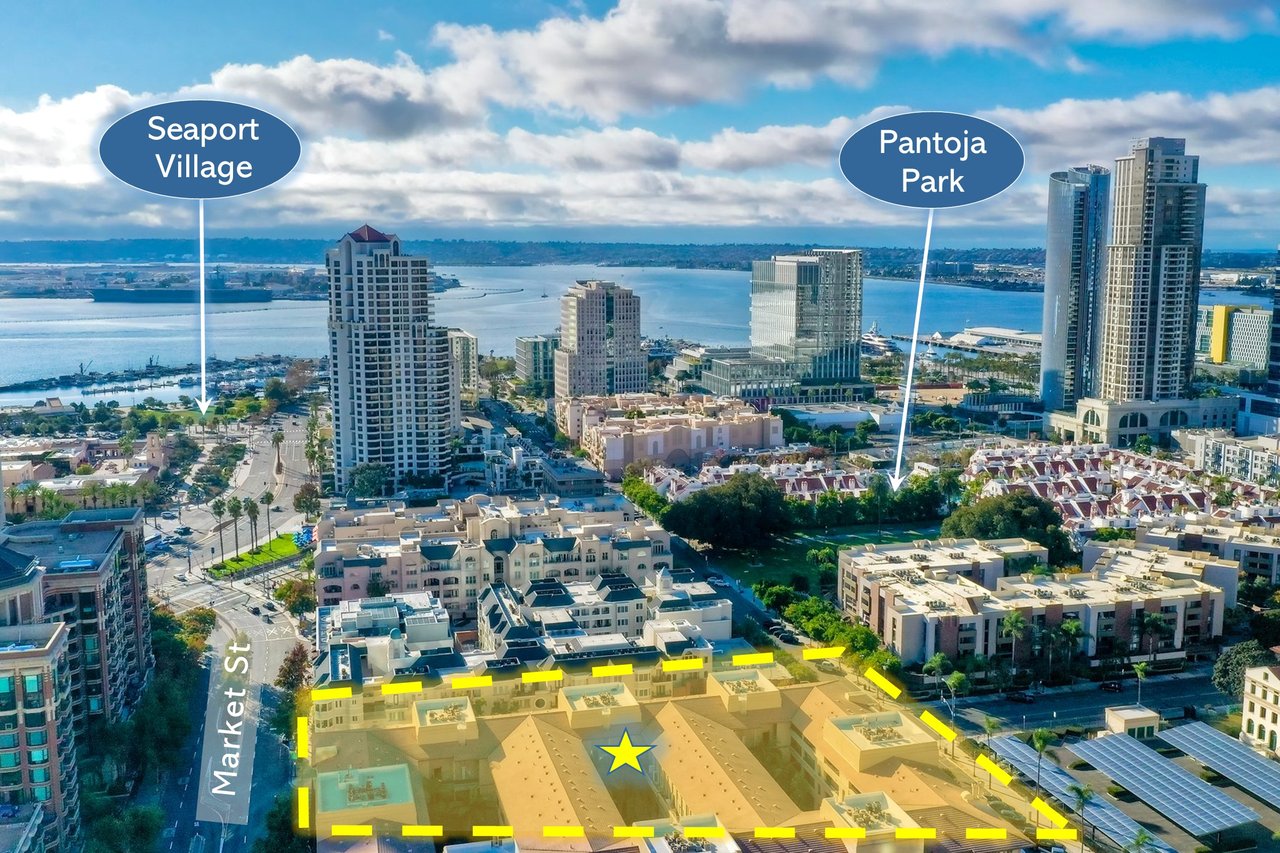
Downtown San Diego is not one building stock. Its Marina District carries some of the market's older luxury towers, including buildings like Meridian, Renaissance, Pinnacle Museum Tower, Park Place, and Harbor Club, many of which are decades past their original construction and are now working through exactly the kind of reserve and insurance questions that decide warrantability. East Village and Little Italy hold a large share of downtown's older mid-rises, the buildings most likely to have deferred balcony or stairway work still outstanding under SB 326.
The clearest evidence that financing tier, not finishes, is doing the sorting shows up in the price-per-square-foot spread. Within downtown's luxury bucket, 2025 sales ranged from $519 to $2,009 per square foot, all inside the same zip code. A spread that wide is not a story about granite counters. It is a story about which of those buildings a conventional lender would still approve.
Why This Matters Even to a Carlsbad or Encinitas Buyer
A downtown condo often enters the picture for a very different reason than a Coastal North County home purchase. It shows up as an investment property, a lock-and-leave second home, or a pied-à-terre for a relocating family member. For that buyer, the building itself still needs to clear review. That is the caveat a North County buyer accustomed to detached-home transactions may not think to ask about, because it simply does not apply to a single-family home the same way.
Before writing an offer on any downtown condo in 2026, it is worth requesting a specific set of documents rather than relying on the listing agent's summary:
- The current reserve study and reserve funding percentage
- The last two to three years of board meeting minutes
- The current insurance declarations page, including deductibles and coverage limits
- Resolution language for any special assessment passed or under discussion in the last 12 months
- Confirmation from the lender that the project has been run through Fannie Mae's Condo Project Manager or the public Condo Status Finder tool
A Few Questions Worth Asking Directly
What does non-warrantable actually mean for me as a buyer? It means the building, not you personally, has failed Fannie Mae or Freddie Mac's project-level review. You can still buy the unit, but typically only with cash, a portfolio loan, or a non-warrantable loan product that carries a higher rate and a larger down payment requirement.
Can I check a building's status before I make an offer? Yes. Your lender can run the specific project through Fannie Mae's Condo Project Manager, and Fannie Mae also offers a public Condo Status Finder for HOAs, managers, and authorized advisors to check known conditions.
Does this only affect downtown, or does it touch condos elsewhere in San Diego County? The August 3, 2026 rule change and SB 326 apply statewide to any qualifying association, so older condo buildings in other parts of the county face the same review, though downtown's concentration of aging high-rises is where the effect is currently most visible.
Median prices tell you what already sold. They do not tell you which building will let you close. If you are weighing a downtown condo against a Coastal North County home, or trying to understand what a specific building's reserve study and insurance history actually mean for your financing, Mike Williams can walk through the documents with you before you write an offer, not after. Schedule a tailored consultation to talk through what a specific building's numbers mean for your next move.
This article is general information, not legal, tax or financial advice. Consult a qualified professional about your situation.